The job market is shifting faster than most university curricula can keep up with. As Nigeria’s graduates prepare to enter the workforce in 2027, the question is no longer just about what degree you hold—it is about what you can actually do. Research from the World Economic Forum suggests that 39% of workers’ existing skill sets could change or become outdated between 2025 and 2030, while 63% of employers already identify skills gaps as a major barrier to business transformation.
Table of Contents for skills graduates should learn to become employable
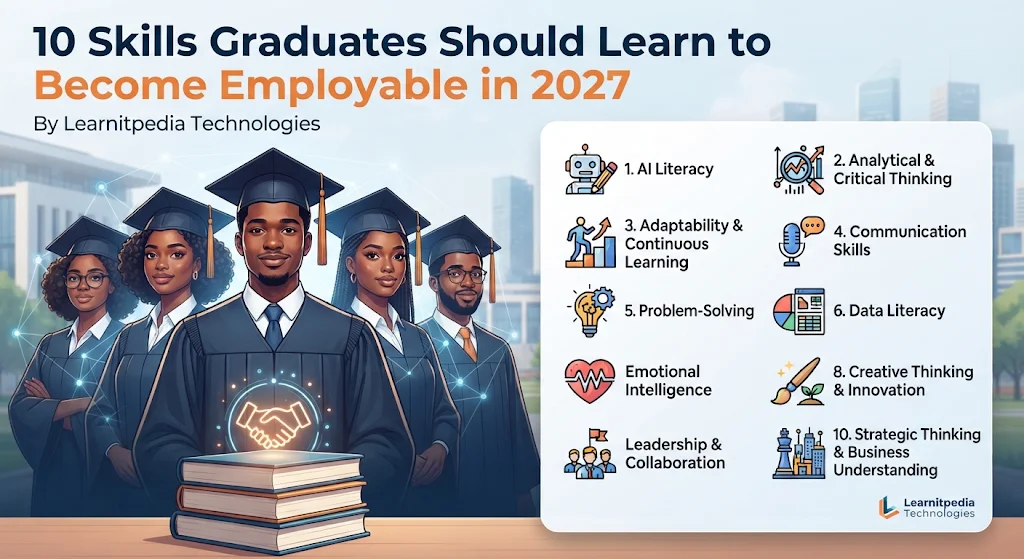
This means the skills graduates should learn to become employable are a blend of technical fluency and distinctly human capabilities. Employers are not simply looking for people who can use a tool; they need people who can think, adapt, communicate, and take responsibility. Below are ten skills that will matter most for graduate employability in 2027, backed by current labour market research. For more career guidance, explore our job and education news.
1. Skills graduates should learn to become employable: AI Literacy
Artificial intelligence is no longer a specialist tool confined to tech teams. It has become a common workplace utility across finance, marketing, administration, and operations. AI literacy means knowing how to use AI tools effectively, write useful prompts, verify AI-generated information, and understand the limitations and risks of automated outputs.
For graduates, this does not mean becoming a machine learning engineer. It means being able to get useful output from a tool, recognise when that output is wrong or misleading, and fold it into a workflow without creating more cleanup work than it saves [citation:20]. Pew Research Center found that 21% of employed Americans already use AI for at least some of their work, a figure that is rising steadily.
2. Analytical and Critical Thinking
As AI becomes better at producing text, summaries, and recommendations, the ability to judge whether an answer is correct becomes more valuable, not less. Seven in ten companies surveyed for the World Economic Forum’s Future of Jobs Report identified analytical thinking as an essential skill [citation:5].
Critical thinking allows you to question assumptions, examine evidence, identify errors, and make decisions based on reliable information. In an AI-assisted workplace, the ability to evaluate technology-generated information may be just as important as the ability to generate it. For graduates, this means practising evidence-based reasoning in coursework and projects, not just memorising facts.
3. Adaptability and Continuous Learning
The traditional idea of learning one profession and using that knowledge for an entire career is becoming less realistic. Workers entering 2027 may encounter new software, AI systems, job responsibilities, and organisational structures several times during their careers. The World Economic Forum found that 70% of surveyed companies considered resilience, flexibility, and agility core skills.
Employers want people who can learn new systems without requiring constant supervision. Graduates can demonstrate adaptability by showing evidence of self-directed learning—online courses, certifications, side projects, or volunteering—that goes beyond the minimum degree requirements.
4. Skills graduates should learn to become employable: Communication Skills
Even highly technical employees need to explain ideas to colleagues, customers, managers, and stakeholders. Strong communication includes writing clearly, speaking effectively, listening carefully, and adjusting your message according to the audience.
In a Pew Research Center survey, approximately seven in ten employed adults considered written and spoken communication very or extremely important for success in today’s economy [citation:5]. For Nigerian graduates, this also means being able to communicate across cultural and linguistic differences, a skill that multinational employers value highly.
5. Skills graduates should learn to become employable: Problem-Solving
Employers do not simply need people who can follow instructions. They need workers who can recognise a problem, understand its underlying cause, evaluate possible solutions, and implement an appropriate response. This is particularly important when AI and automation alter existing workflows, because new systems can create unfamiliar operational problems.
Graduates can build this skill by treating coursework and internships as opportunities to diagnose and fix real issues, not just complete assignments. The ILO identifies problem-solving as a core employability skill that helps young people transition more successfully into decent work [citation:19].
6. Data Literacy
Data literacy extends beyond specialist roles. Even if you are not a data scientist, you will likely need to interpret trends, question assumptions, and communicate findings in almost any professional role. The U.S. Bureau of Labor Statistics projects employment for data scientists to grow by 33.5% between 2024 and 2034, reflecting broader demand for data expertise [citation:5].
For graduates outside technical fields, basic data literacy means being comfortable with spreadsheets, understanding key performance indicators, and being able to distinguish activity from results. A marketing graduate, for example, should be able to examine conversion rates rather than judging a campaign solely by how many posts were published [citation:5].
7. Emotional Intelligence
Technical skills may get you shortlisted, but emotional intelligence often determines how far you go. Emotional intelligence includes self-awareness, empathy, the ability to accept feedback, and the capacity to build professional relationships. The ILO lists emotional intelligence among the core skills that help graduates collaborate and respond to change [citation:19].
In practical terms, this means being able to work with people who have different working styles, manage your own reactions under pressure, and contribute to a healthy team environment. Employers increasingly look for these qualities in behavioural interviews and group assessments.
Digital Skills Africans Should Learn in 2026
8. Creative Thinking and Innovation
Automation can handle repetitive processes, but organisations still need people who can identify opportunities, generate ideas, and approach unfamiliar problems from different perspectives. The World Economic Forum reported that 64% of surveyed employers considered creative thinking a core skill [citation:5].
Creative thinking is not limited to careers in advertising or design. It is valuable in engineering, business, education, healthcare, finance, and technology. Graduates can develop it by questioning established processes and proposing alternative solutions in their projects and internships [citation:1].
9. Leadership and Collaboration
Leadership is not reserved for people with formal management titles. It means taking responsibility, coordinating projects, supporting colleagues, and helping teams reach shared objectives. The World Economic Forum found that 64% of employers consider leadership and social influence core skills [citation:5].
Collaboration across disciplines is also increasingly relevant, especially when projects require coordination between finance, operations, marketing, and technology teams. Graduates who can demonstrate teamwork through group projects, volunteer work, or student leadership roles have a clear advantage [citation:8].
10. Strategic Thinking and Business Understanding
Technical knowledge becomes more valuable when you understand why your work matters to the organisation. Strategic thinking means understanding business objectives, prioritising important tasks, and connecting your daily work to wider organisational goals [citation:1].
The World Economic Forum found that 63% of employers consider skills gaps a barrier to business transformation, and professionals who understand organizational priorities can make better decisions about time and resources [citation:5]. For graduates, this means paying attention to how your role contributes to revenue, customer satisfaction, or operational efficiency—not just completing tasks in isolation.
How to Build These Skills Before Graduation
Use AI tools deliberately. Practise with ChatGPT, Claude, or Copilot on real tasks, then check the output critically. Document a project where AI helped you work faster, and one where you had to correct it.
Take on a leadership role. Run a student club, organise an event, or lead a group project. These experiences give you concrete stories for interviews.
Build a portfolio. Employers increasingly rely on skills-based hiring. A dashboard you built, a report you wrote, or a project you completed demonstrates more than a certificate alone.
Learn basic data skills. Excel, Power BI, or even basic SQL can set you apart in non-technical roles.
Practise communication. Write clearly, present in class, and learn to explain technical concepts to non-technical audiences.